Showing posts with label spain. Show all posts

Tuesday, April 27, 2010

The Power of Leaving Stuff Out, or Home again, home again, riggety jig

Jan and I made our way home again. The flight back had the best quality of all: it was uneventful. Well, actually, I'm not home yet, though Jan is. I landed in Toronto just in time to teach a programming course here for Learning Tree. So I'm in another (but familiar) hotel.

Coming back, we got to spend a day in Madrid wandering around the Passeo de Prado, eating on the boulevard, visiting museums, and picking up some last minute purchases. We got to the Raina Sofia museum where I got to stand in front of Guernica (there was lots of other neat modern art, too, most from artists we'd never heard of and a huge Calder mobile in a beautiful courtyard).

And, of course, I got into FNAC and bought some more CDs. I'm taking home about 18 CDs of music by Spanish musicians ranging from "early music" from European, Sephardic, and Moorish traditions from Jordi Savall and Eduardo Paniagua; to flamenco/nuevo flamenco artists like Enrique Morente, Paco de Lucia, Ojos de Brujo, Ketama; to pop artists like Fito and El Barrio; and some jazz from Chano Dominguez and Jorge Pardo. I've also discovered that I will probably never enjoy real flamenco singing in any but the smallest quantities. .

We discovered we were too footsore and tired from getting up at 5:00 and the stress of traveling to take as much advantage of Madrid as we could have. When we got to the Prado museum there was some sort of lineup system in place that allowed people to enter and leave in large groups and it all looked too complicated for us. Similarly, we hoped to take in a flamenco show in the evening but, instead, crawled into bed (well, I had a long bath first). I would have loved to have seen more Goyas, Velasquez, Murillos (we saw some in Vallencia). There was a Singer Sargent show that would have been wonderful. We will have to come back.


We got around in Madrid because of the fabulous Metro system. As a technical writer, it was great to see another variation of Harry Beck's map, originally developed for the London tube system. The London tube map is probably the most used technical drawing in the world (and a great book about is Mr. Beck's Underground Map: a history by Ken Garland) and should be an inspiration to technical writers everywhere.

What makes Beck's map interesting is that it works by stripping information out and leaving only what's necessary--and that's presented in a very stylized format that permits only horizontal, vertical, and 45 degree lines. The London map is not only useful, it is loved. When a recent version eliminated the stylized depiction of the Thames, public outcry forced it back in.

It was also good to see that the field keeps evolving. Most variations on Beck's map were failures. What has appeared more recently leaves the map alone and concentrates on helping the traveler with signage in the station. The new work draws on the field of wayfinding which supports how people navigate through space. In many transit systems, as you walk through the stations, you'll find maps that list all (and only) the stops on the route that you are approaching. This information is also presented in a very stylized order: no matter how twisty the route is, it's shown as a straight line; the station next on the route appears at the top and the station last on the route appears at the bottom. Again: less information, more help.


Reading or read

Sunday, April 18, 2010

Travel Arrangements, Or I can't see a volcano from here

So now we can't leave Spain, which is an interesting experience. We were booked on a flight out tonight which would have got us to Toronto on Monday, in time for me to teach for Learning Tree on Wednesday. We gave that up because (a) it didn't seem likely to happen, and (b) the longer we waited the later it was going to be before we could get another flight.

So now, we're booked (I think) on a flight that leaves Sunday morning and gets us into Toronto on Sunday, in time to teach for Learning Tree on Tuesday. The reason for the "I think" is that we're not sure that Jan has a ticket for the first leg of the flight from Alicante to Madrid Saturday morning. Assuming she does (and SpanAir told me--I think--that she does) we get a day in Madrid: the Prado! Flamenco!

It was an interesting experience talking to Air Canada about rebooking. The first question I was asked was "Can you get to Rome" (all roads really do lead, apparently). It's an 18 hour drive (I smell !!road trip!!). We've also looked at taking a ferry across the Mediterranean to, for instance, Tunisia where for some astronomical sum of money, I can fly to New York.

So that's our current situation: To fly from where I'm not to somewhere I don't need to be for more money than I have. Of course, there are worse situations than to be stuck in someone's house in Spain...though we have run out of food. So it's off to the local restaurant tonight and the market tomorrow.

But this is the beauty of being a technical writer. I got eight columns done for Visual Studio Magazine (my "Practical ASP.NET column"), just about finished tech-editing a book for Pearson, arranged an interview for the ToolTracker blog (also with Visual Studio Magazine), and got some work done revising my ASP.NET course. And, even if I'd lost my Internet connection, I still would have been able to do about three quarters of those jobs.

Reading or read:

Friday, April 16, 2010

The Power of People, or Stuck inside of Toledo with the immobile blues again (mama)

Every once in awhile, it's good to be reminded that every piece of technical writing is actually a substitute for a real person. My wife and I are houseswapping in Spain and drove to Toledo last Sunday. At the exact moment that we pulled into the hotel garage in Toledo, billows of smoke poured out of the car and I lost power steering. I was able to wrestle* the car into a parking spot but that's where it stopped. On Monday, I started to look for a solution to my problem: to get the car fixed and get back to the house we were staying in Obra.

Technical writing helped: The note we had from the people we were houseswapping with pointed us to the document that told us how to get in touch with their roadside assistance service. The nice man from England that I spoke to had a tow truck to us within 15 minutes. After that, however, it was a question of how much English the people I had contact with could speak--there are real language skills!. So this column is a tribute to the mechanic who picked up the car but mostly to the amazing clerks at the Casona de la Reyna who took care of us (a great hotel, by the way, right at the edge of the Jewish quarter).

So, here's what I was reminded of: In the end, great technical writing, one way or another, connects us to other people. Either the material is a proxy for that other person or it's a conduit that allows us to make contact. Either way, technical writing is an opportunity for us to help each other.

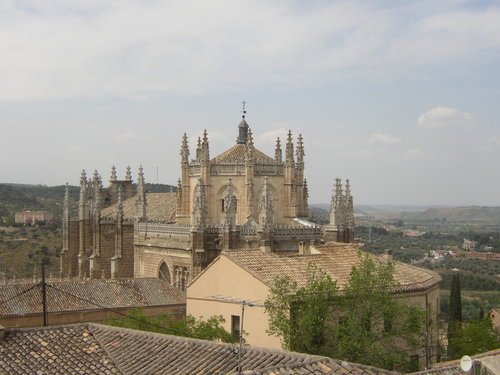
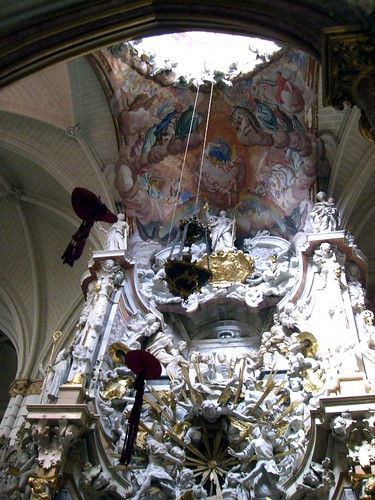
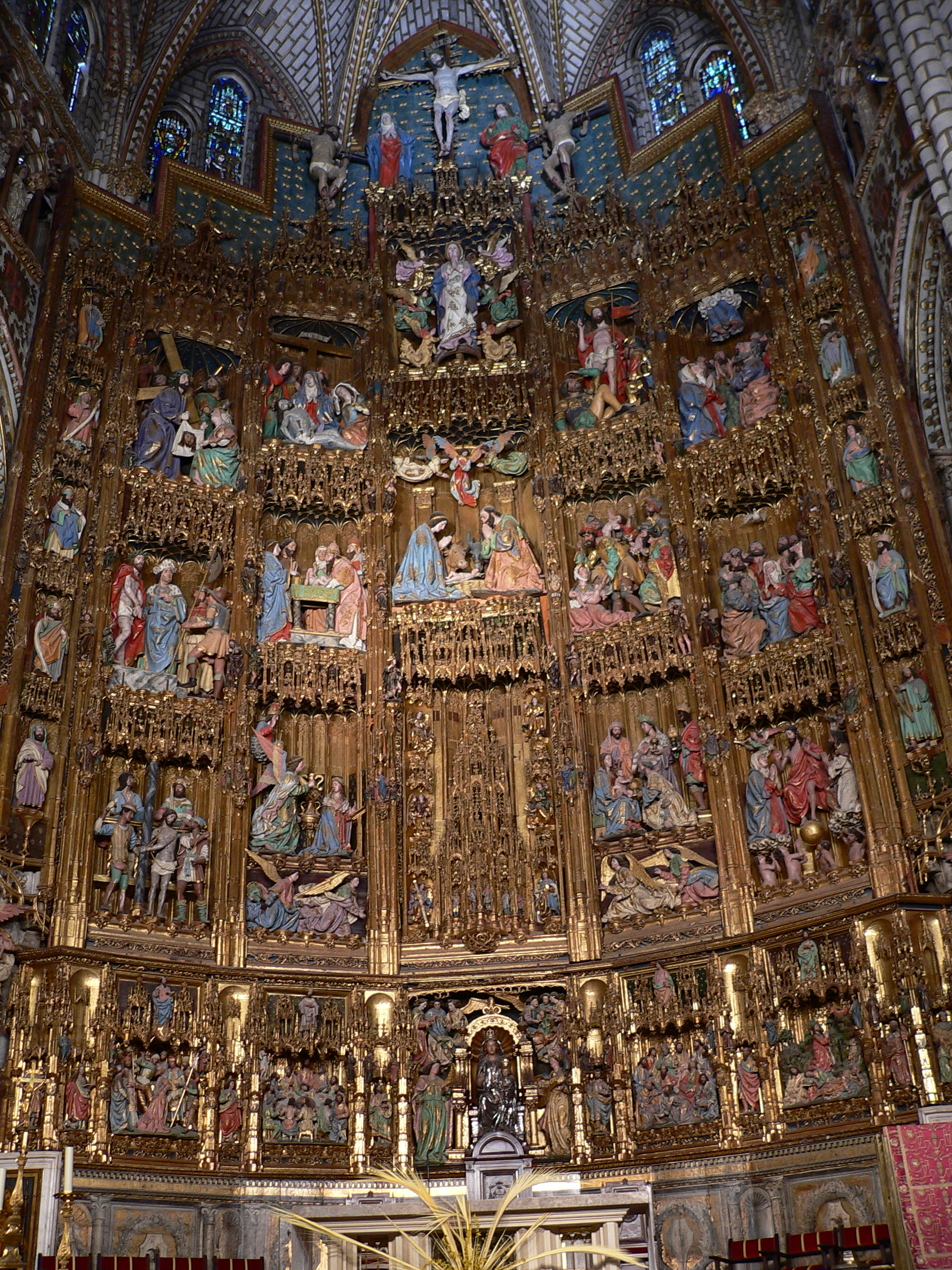
And Toledo itself was amazing. And I mean that literally: I was amazed, constantly. I kept wandering around with this big grin on my face. The cathedral is a once in a life time experience: To stand under the Transparente is something you will never forget; the main chapel's altar is--like the Grand Canyon--more than the human eye and mind can actually absorb. And that leaves out the treasure (with its illuminated manuscripts and monstrance), the choir, and the art in the sanctuary (in one corner you are facing an El Greco, a Titian, a Raphael, and--my favourite--a Caravaggio). We were there four days instead of our planned 2.5 but, as a result, we got to see many things we would otherwise have missed. We also had great food: seafood (the Naviera--it turned out that the pulpy thing I was poking at was the fish's eye), great local lamb and pork (24 Alfilerito 24), and roast suckling pig (Del Cardenal). So, not a bad thing.

We did end up missing a concert we had booked in Valencia (Tokyo String Quartet--doing a lot of 20th century stuff so it had a real potential to drive Jan mad. But their first violinist is a Canadian, as was their previous first violinist). On the way home, we did stop in Valencia where we visited the FNAC and picked up a bunch of CDs by Spanish musicians (and "Sinatra and Basie at the Sands" for about $10.00CDN). We were also able to wander the museum of  Belle Artes where we saw more wonderful things.


*not a metaphor: I wrestled a little in my youth at the YMCA and this recreated the experience excactly.

Reading or Read

Monday, April 5, 2010

Learning from Instructional Design, Or Stealing from the best

While I'm here in Spain I'm grasping the opportunity to take some e-learning from Daryl L. Sink & Associates (they're the organization that Learning Tree partnered with to develop Learning Tree's Reality Plus courses). Since I do some instructional design for a couple of my clients, over the last 12 to 18 months I've been concentrating on increasing my knowledge in the field (my experience tends to take care of itself)--this training is part of that process.

The course that I'm taking from DSA is their "Course Development Workshop". I've been meaning to attend one of their "in-person" presentations of this course but work, so far, has always interfered. I finally decided that if I was going to do it at all, I'd best take advantage of their distance education, web-based version. I'm picking up lots of good stuff.

One of the tools that the course promotes is, I think, going to be especially useful to me and not only when I'm doing instructional design but also when I'm doing technical writing. In the course it's referred to as
   M - A = D: Master - Actual = Difference

The tool consists of a three column table that lists:
  • The performance of a "Master" (not a "superstar" because it costs too much to train people to be superstars)
  • The performance you currently have (the "actual")
  • The difference

So, for technical writing, you might have this when comparing a new hire to a competent technical writier:

MasterActualDifference
Adjusts content and format for different audiences Writes what he or she would want to read Does not understand the demands of different audiences

It's actually a four column tool because DSA uses this in conjunction with a second table that lists the cause for each difference (e.g. knowledge, attitude, lack of essential tool).

In applying this to technical writing, a tweaked version of this table could be very useful in defining the knowledge domain for a document--one of the critical issues in designing a document. This table could go a long way to addressing the knowledge domain question: "What needs to be addressed in a particular document for a particular audience?" You only need, after all, to address the differences.

Of course, defining the knowledge domain is just the first step. Once you have defined the difference, the next step is determining how to address it--what content should be included to help the audience move from their current state to the required state?

It seems to me a small step to modify DSA's table to address the difference in knowledge/information between the required level of knowledge in the domain vs. the level of knowledge in document's audience. And it's an equally small step to extend the tool to include a tactic for addressing that difference. If I was writing a textbook on technical writing, I might create this version of the DSA table as part of designing the textbook's content:

RequiredActualTactic
Specify the different requirements of various audiences for the same knowledge domain Treats all audiences as having the same needs as he or she does Provide examples of different audience demands for the same knowledge domain. Contrast with what the author finds valuable


I'm finding this tool useful (I tried it out as part of revising a course proposal I put together for one of my clients) but obviously it needs work. Just because there is a difference and you have a way of addressing it, you don't necessarily have to address that difference. A prioritization step is also needed (DSA divides potential content up into three categories: Could, Should, and Must). It also seems to me that you need both tables: one to help you accurately define the difference and one to help you define a way of addressing it. Perhaps a five column version would work best: Master, Actual, Difference, Cause, Tactic? Too unwieldy?

And another critical point: DSA's original (M - A = D) spells out a word. My version (R - A = T) spells out an unfortunate word. And, as we all know, the success of any tool is dependent on its acronym.

Reading or read

Tuesday, March 30, 2010

Looking for Books, or When in Spain do like the Brits

Arrived in Spain Sunday night and spent yesterday (Monday) running around with Jan (and the other two members of our party) getting groceries and lost (not necessarily in that order).

I look on our visits to foreign countries as an excuse to read authors (and get music) from that country. So I look for bookstores and ransack them for local authors. I do recognize looking for English books in a foreign country is sort of dumb to begin with: People in Spain read in Spanish so the books I find here are going to be in Spanish.

The search isn't completely stupid, however. To support the tourist/ex-pat brigade the bookstores (especially at the airport) typically do stock a large number of books in English...but all by English authors (with the odd 'international success' translated from the original language). And, in town, the bookstores often have a shelf of books of "local authors in English." This was true in the two or three bookstores I went into in Stockholm, for instance, and the bookstore in Arnhem in the Netherlands that I visit when we're there. I draw no conclusions from this shelf often being flat on the ground--I'm still limber enough to get down and look.

Anyway, here in Spain we're staying in a small town called Orba (about an hour from Alicante and an hour and a half from Valencia)--no bookstores here. Everyone else arrived last Wednesday  and had already been to the local markets so, today, at least in part to satisfy my hunger for bookstores, we went to a mall. I did find a bookstore but it was aimed exclusively at the ex-pat market. Lots of books in English but exactly six books by Spanish authors:
  • Three "world classics"
    • Don Quixote by Cervantes (Penguin)
    • The Exemplary Tales by Cervantes (Penguin)
    • The Conquest of New Spain by Diaz (Penguin)
  • A Dan Brown kind of thriller set in Italy and the US
  • Two "literary" novels
    • Soldiers of Salamis--A novel set in the Spanish Civil war
    • All Souls--a novel by a contemporary Spanish author (Javier Marias)...set in Oxford and based on the two years he spent teaching in Oxford.
I had actually found more variety in "Spanish authors in English" at the used bookstore I go to in Toronto. I had found "Soldiers of Salamis" there, a novel by Galdos (who, I gather, is considered the greatest Spanish author after Cervantes), several different versions of "Don Quixote", Zafon's 'international bestseller' "The Shadow of the Wind", a book of poetry by Lorca, and a book by a Galician author I hadn't heard of before that was delightful. And two of those books I stumbled across by accident because the authors had 'obviously Spanish' names that were close to the names of Spanish authors that I was looking for (and not finding)--which means there were probably more books by Spanish authors and I just didn't find them.

Meanwhile, the supermarket we went to had oodles and oodles of books by Spanish authors...all in Spanish. It's like some cruel joke. We're off to Valencia tomorrow for our first visit so, perhaps, I'll do better there.

What's that got to do with technical writing? It got me thinking: How often do we read the books that our audience reads? How well do we immerse ourselves in the language and culture of our audience? When we write for a very different audience, do we come across as "tourists"--not knowing the language or almost getting the words right but always just missing?

Reading or Read